
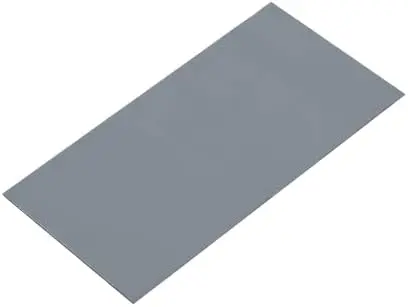
GP-Ultimate 15W Thermal Pad, 90 x 50 x 0.5 mm
15 W/mK · 90 × 50 × 0.5 mm
4.7 1,021 ratingscounted across all 5 thicknesses of this sheet size

Thermal Pads
4.7 3,062 ratingscounted across all 5 thicknesses of this sheet size
The thinnest GP-Extreme sheet: 0.5 mm of 12 W/mK gap filler on an 80 x 40 mm pad, cut for memory chips and tight laptop clearances.
$9.49$10.99
In stock
Sold and shipped by an authorized retail partner. Price shown was current when this page was built.
Check price and buyHalf a millimeter is the thickness you reach for when the heatsink almost touches the chip already. On graphics cards it is the VRAM gap on a well-machined cooler, on laptops it is the strip between a copper spreader and a controller IC, and on an M.2 drive it is everything between the NAND and the motherboard shield. This 80 x 40 mm sheet of GP-Extreme carries 12 W/mK through that gap without adding height the cooler cannot absorb.
A 0.5 mm pad exists for surfaces that are nearly coplanar. Reference-design graphics cards, thin-and-light notebook boards and NVMe drives under a motherboard shield all fall into that band. The rule of thumb worth keeping is simple: measure the gap, then pick the pad that fills it with a light squeeze rather than one that forces the heatsink to sit proud of its mounting posts.
The sheet gives you 3,200 square millimeters to work with, which on most cards is enough for a full row of memory packages plus a couple of spare offcuts. Lay the cooler plate down, mark the contact islands with a pencil on the protective film, and cut on a self-healing mat with a fresh blade. Cutting through the film keeps the pad clean and stops the edges rolling under the knife.
Thin pads are the ones people ruin. Peel one liner at a time, keep the second liner in place while you position the piece, and lift by the film rather than the compound. If a strip stretches out of shape it will not recover, because 12 W/mK filler is loaded with conductive particles and behaves more like soft clay than rubber. Work slowly and a 0.5 mm piece will go down flat on the first attempt.
For a single mid-range graphics card teardown, one sheet usually covers the memory row and the small inductor islands with material left over. For a laptop refresh it is generous. The compound does not cure or dry out, so offcuts stored between their liners in a sealed bag stay usable for the next job rather than turning brittle on the shelf.
| Thickness | Pack | Price | |
|---|---|---|---|
| 0.5 mm this page | 1 sheet | $9.49 | |
| 0.5 mm | 2 sheets | $17.99 | View |
| 1 mm | 1 sheet | $11.49 | View |
| 1.5 mm | 1 sheet | $11.99 | View |
| 1.5 mm | 2 sheets | $19.99 | View |
| 2 mm | 1 sheet | $12.99 | View |
| 2 mm | 2 sheets | $23.99 | View |
| 2.5 mm | 1 sheet | $14.97 | View |
| 3 mm | 1 sheet | $14.99 | View |
| 3 mm | 2 sheets | $24.99 | View |
15 W/mK · 90 × 50 × 0.5 mm
4.7 1,021 ratingscounted across all 5 thicknesses of this sheet size
15 W/mK · 90 × 50 × 0.5 mm · 2 sheets
4.8 734 ratingscounted across all 4 thicknesses of this sheet size
15 W/mK · 120 × 20 × 0.5 mm · 2 sheets
4.6 491 ratingscounted across all 4 thicknesses of this sheet size
15 W/mK · 120 × 20 × 0.5 mm
4.5 391 ratingscounted across all 4 thicknesses of this sheet size


